If you sand curves, inside corners, and template-shaped parts regularly, the right benchtop spindle sander can save time and improve consistency. These compact machines are designed to handle detailed shaping with less fatigue than hand sanding.
We narrowed the field to 10 strong options with a focus on table stability, oscillation performance, sleeve range, and overall value for home shops and serious DIY users.
Best 10 Benchtop Spindle Sanders Picks for 2026
Compact Shop Pick
WEN 6510T Oscillating Spindle Sander
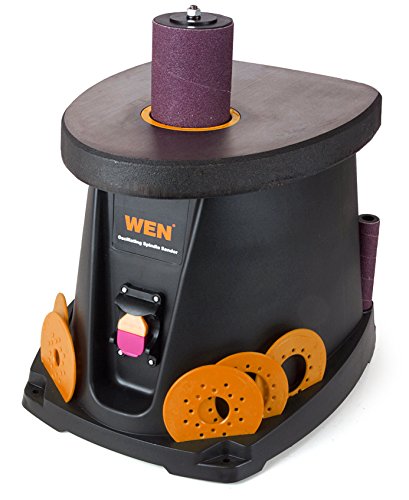
- 3.5 amp motor with 58 OPM and 2000 RPM
- Onboard accessory storage and dust port
- Designed for curves, contours, and irregular shapes
Best For: basic curved-edge sanding in a compact shop
Sturdy Curve-Sanding Choice
Triton TSPS450 Cast Iron Oscillating Sander

- Cast iron top and 3.5A motor
- Oscillates and rotates at up to 2000 RPM
- Includes 6 sleeves, drums, and inserts
Best For: stable sanding of curves and irregular shapes
Most Versatile Combo
WEN 6524 Belt and Spindle Sander
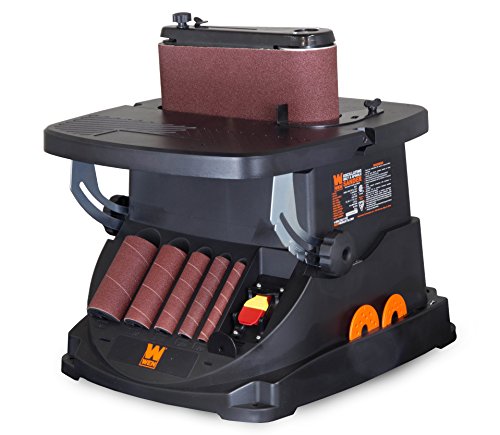
- Belt and spindle sanding in one machine
- Spindle speeds up to 2000 RPM; belt up to 1575 FPM
- Includes beveling table, drums, and onboard storage
Best For: shops that want one machine for both belts and spindles
Fastest Spindle-Only Model
VEVOR 2400RPM Oscillating Spindle Sander

- 2400 RPM motor with 5/8-inch stroke
- Large 15.6 x 11.6-inch cast iron table
- Six sleeves, six inserts, and storage slots
Best For: faster spindle sanding on a wider worktable
Top Pick for Versatility
WEN AT6535 3.5-Amp Oscillating Spindle Sander
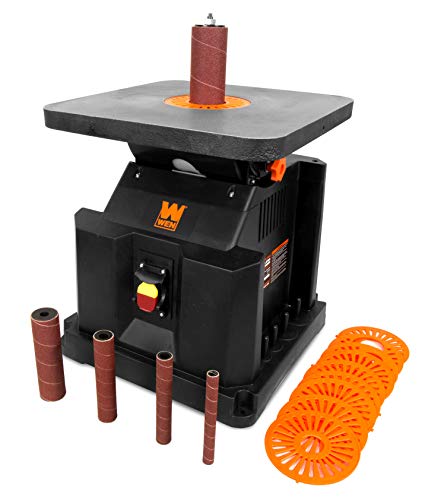
- Five sleeve sizes from 1/2 inch to 2 inches
- Large 14-1/2 x 14-1/2-inch table bevels to 45 degrees
- Onboard storage keeps accessories organized
Best For: Woodworkers who need a versatile benchtop spindle sander for curved and angled pieces
Best for Wide Workpieces
VEVOR 2400RPM Benchtop Spindle Sander with 6 Sleeves

- 2400 RPM motor for efficient sanding
- Six sleeve sizes from 1/2 inch to 3 inches
- Wide 15.4 x 16.3-inch cast iron worktable
Best For: Users sanding larger furniture parts or needing a wide, stable work surface
Heavy-Duty Shop Choice
Rikon 50-300 Oscillating Spindle Sander

- All-steel construction with metal housing
- 1/2 HP motor and cast iron tilting table
- Five spindle diameters from 1/2 inch to 2 inches
Best For: Woodworkers wanting a sturdy, heavy-duty benchtop spindle sander for shop use
Compact Benchtop Sander
VEVOR 2000RPM Oscillating Spindle Sander

- 2000 RPM sanding for curves and contours
- Includes 6 sleeves and 6 table inserts
- Dust port and storage slots improve workflow
Best For: Hobbyists wanting a compact spindle-only sander for finishing work
High-Speed Combo Sander
VEVOR Oscillating Belt and Spindle Sander
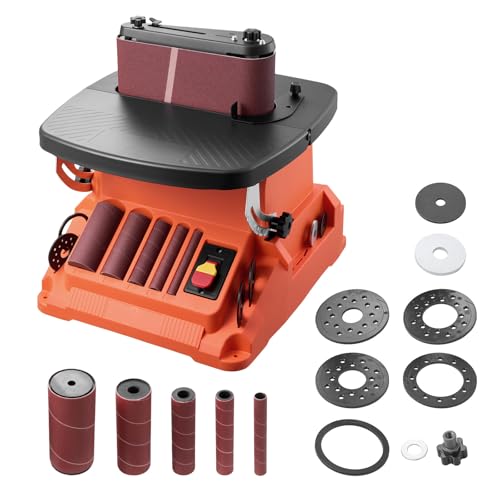
- 2400 RPM for fast sanding performance
- Includes belt sanding plus 5 spindle sleeves
- Tilting table and dust port add versatility
Best For: DIYers needing a fast combo sander for curves, edges, and angles
Compact Shop Pick – WEN 6510T Oscillating Spindle Sander
For woodworkers comparing benchtop spindle sanders, the WEN 6510T is a straightforward option built around a 3.5 amp motor, 58 oscillations per minute, and up to 2000 RPM. It is aimed at smoothing curves, contours, and other shaped edges while keeping setup simple with onboard accessory storage and a dust port for collection.
Best For: Shops that want a compact oscillating spindle sander with basic, practical features for curved-edge sanding.
Pros:
- 3.5 amp motor delivers 58 OPM and up to 2000 RPM.
- Onboard storage helps keep accessories organized.
- Dust collection port supports cleaner sanding sessions.
- Built for sanding curved and irregular shapes.
Cons:
- Only the spindle sander is included in the package details provided.
- No cast-iron table or oversized workspace is listed.
- Best suited to standard benchtop sanding tasks rather than heavy-duty production work.
Overall, the WEN 6510T is a practical benchtop spindle sander for users who want essential oscillating performance, simple storage, and dust-control support without extra complexity.
Sturdy Curve-Sanding Choice – Triton TSPS450 Cast Iron Oscillating Sander
The Triton TSPS450 stands out among benchtop spindle sanders with a cast iron top, a 3.5A motor, and oscillating action that supports smoother finishes on contours, arcs, curves, and other irregular shapes. It runs at up to 2000 RPM and includes multiple sleeves, drums, and table inserts for common sanding sizes.
Best For: Woodworkers who want a cast-iron benchtop spindle sander for shaping curves and irregular edges.
Pros:
- Cast iron top adds a sturdy work surface.
- Rotating and oscillating action helps improve sanding efficiency and finish quality.
- Includes 6 sanding sleeves, matching rubber drums, and table inserts.
- On-board storage keeps accessories close at hand.
Cons:
- Sleeve range is limited to 1/2 to 3 inches.
- Only one sander is included, with no extra accessories beyond the listed kit.
- Best suited to contour work rather than large flat sanding jobs.
In practical terms, the TSPS450 is a solid choice when table stability and curve-sanding versatility matter more than maximum size or multi-tool capability.
Most Versatile Combo – WEN 6524 Belt and Spindle Sander
Among benchtop spindle sanders, the WEN 6524 is the more versatile pick because it combines spindle sanding with a 4 x 24 inch belt attachment. Its 3.5-amp motor drives both functions, with belt speeds up to 1575 FPM and spindle speeds up to 2000 RPM, making it a flexible option for shops that need more than one sanding method.
Best For: Woodworkers who want both belt and spindle sanding in one benchtop machine.
Pros:
- Combines a spindle sander and a belt sander in one unit.
- Spindle sizes range from 1/2 inch to 2 inches.
- Up to 1575 FPM belt speed and 2000 RPM spindle speed.
- Includes a beveling work table and onboard storage.
Cons:
- Larger and more complex than a dedicated spindle-only machine.
- Only four rubber sanding drums are included.
- May be more tool than needed if you only sand curves and contours.
If you want a single benchtop setup for both edge shaping and contour sanding, the 6524 offers the broadest function set of the group.
Fastest Spindle-Only Model – VEVOR 2400RPM Oscillating Spindle Sander
The VEVOR oscillating spindle sander is built for users who want a larger benchtop sanding area and a faster top speed than many basic models. It offers 2400 RPM, a 5/8-inch stroke, six sleeve sizes, and a 15.6 x 11.6-inch cast iron worktable, making it a strong fit for furniture finishing, crafts sanding, and DIY woodworking.
Best For: Projects that benefit from a wider cast-iron table and faster oscillating spindle sanding.
Pros:
- 2400 RPM maximum speed is higher than the other listed spindle-only models.
- 15.6 x 11.6-inch cast iron table provides a spacious work area.
- Includes 6 sleeve sizes and 6 table inserts for different curves and workpieces.
- Built-in storage slots help keep sleeves and inserts organized.
Cons:
- Only spindle sanding is listed, with no belt-sanding function.
- Heavier than some compact options at 33.1 pounds.
- Best suited to woodworking and finishing tasks, not general-purpose sanding.
For users who want a benchtop spindle sander with a larger table and the fastest speed in this roundup, the VEVOR is an appealing upgrade.
Top Pick for Versatility – WEN AT6535 3.5-Amp Oscillating Spindle Sander
WEN AT6535 3.5-Amp Oscillating Spindle Sander with Extra Large Beveling Table Top
Check Price On AmazonIf you want a practical benchtop spindle sander for curved edges, angled pieces, and general shop cleanup, the WEN AT6535 gives you a broad mix of sleeve sizes and a large work surface. Its 3.5-amp motor runs at 2000 RPM with 58 oscillations per minute, making it a solid fit for routine sanding tasks on furniture parts and DIY projects.
Best For: Woodworkers who want a versatile benchtop spindle sander with a roomy table and multiple sleeve sizes.
Pros:
- Five sanding sleeve sizes from 1/2 inch to 2 inches for different curves and profiles
- 14-1/2 by 14-1/2-inch table bevels up to 45 degrees for angled workpieces
- Onboard storage helps keep accessories and sandpapers organized
- 2000 RPM motor with 5/8-inch stroke for oscillating sanding action
Cons:
- Table size is large, which may take up more bench space
- Focused on standard sanding tasks rather than heavy-duty industrial use
This WEN model stands out for its balance of size, sleeve options, and table adjustability. If you need a dependable benchtop spindle sander for mixed curved-work projects, it offers a straightforward feature set without overcomplicating the job.
Best for Wide Workpieces – VEVOR 2400RPM Benchtop Spindle Sander with 6 Sleeves
For buyers comparing benchtop spindle sanders for larger parts, this VEVOR model emphasizes a wide cast iron worktable, six sleeve sizes, and a high-speed 2400 RPM motor. It is aimed at furniture finishing, crafts sanding, and DIY woodworking where smooth sanding on flat or contoured surfaces matters.
Best For: Users who need a wide worktable and a broad sleeve range for furniture and craft sanding.
Pros:
- 2400 RPM rotation supports efficient sanding on flat, curved, and contoured surfaces
- Six sleeve sizes from 1/2 inch to 3 inches for different workpiece shapes
- 15.4 x 16.3-inch cast iron worktable provides a spacious, stable surface
- Integrated storage slots help keep sleeves and table inserts organized
Cons:
- Heavier unit at 37.5 pounds, so it is less portable than smaller benchtop options
- Dust collection depends on connecting a vacuum hose to the dust port
The VEVOR is a strong fit if table space and sleeve flexibility are top priorities. Its wider work surface and extra sleeve size make it especially practical for sanding larger furniture components and varied DIY projects.
Heavy-Duty Shop Choice – Rikon 50-300 Oscillating Spindle Sander
If you want a more substantial benchtop spindle sander for accurate curved-edge work, the Rikon 50-300 leans into all-steel construction and a heavy 76-pound build. Its 1/2 HP motor, cast iron tilting table, and five spindle diameters make it a practical option for shops that value stability and durability.
Best For: Woodworkers who want a sturdy, heavy-duty oscillating spindle sander with a durable build.
Pros:
- All-steel construction and metal housing for a heavy-duty feel
- 1/2 HP motor with oscillating action for fast, accurate curved-edge sanding
- Five spindle diameters from 1/2 inch to 2 inches with 6 table inserts
- Cast iron tilting table supports stable shop work
Cons:
- Weighs 76 pounds, so it is not easy to move around
- Smaller spindle range than some models that include larger sleeves
The Rikon 50-300 is built for users who care more about rigidity and long-term shop use than portability. If your priority is a solid oscillating spindle sander for curved board edges, this one brings a durable, no-nonsense setup.
Compact Benchtop Sander – VEVOR 2000RPM Oscillating Spindle Sander
If you want a straightforward benchtop spindle sander for furniture finishing and DIY woodworking, this VEVOR model keeps things simple and practical. It focuses on smooth sanding across flat, curved, and contoured surfaces, with a compact setup that still gives you a roomy cast aluminum table and multiple sleeve sizes.
Best For: Hobbyists and woodworkers who want a compact oscillating spindle sander for mixed shaping and finishing tasks.
Pros:
- Runs at 2000 RPM for efficient sanding on curves, contours, and flat areas
- Includes 6 sanding sleeves and 6 table inserts for a wide range of workpiece sizes
- 0.59-inch stroke helps it handle both thin and thicker pieces
- Built-in dust port supports cleaner sanding with vacuum hookup
Cons:
- Spindle-only design limits it if you also want belt sanding capability
- Smaller capacity may be less appealing for larger shop workloads
Overall, this is a practical pick if you mainly need a benchtop spindle sander for detailed woodworking and cleanup-friendly finishing work. The included storage slots and sleeve variety make it especially convenient for regular project use.
Versatile Combo Sander – 500W Oscillating Spindle Belt Sander
For buyers comparing benchtop spindle sanders that can do more than one job, this 2-in-1 machine stands out with both belt and spindle sanding. It is built for flat edges, curves, and angled work, so it suits woodworkers who want one tool to cover a broader range of sanding tasks.
Best For: Woodworkers who want a combination sander with spindle and belt capability in one benchtop machine.
Pros:
- 2-in-1 design combines a 4×24 belt sander with spindle sanding
- Variable speed from 1000 to 2000 RPM helps match different materials
- 0-45° tilting table supports angled sanding and bevel work
- Includes 5 spindle sizes and a dust collection port
Cons:
- Heavier 38-pound build may be less portable than simpler benchtop units
- Larger footprint can take more shop space than a spindle-only sander
This is a strong pick if you want the flexibility of a combination machine instead of a single-purpose spindle sander. The variable speed motor and tilting table make it especially useful for mixed woodworking projects and detail work.
High-Speed Combo Sander – VEVOR Oscillating Belt and Spindle Sander
This VEVOR model is a practical choice if you want benchtop spindle sanders with added belt sanding capability. It reaches 2400 RPM and pairs a 5/8-inch stroke with a tilting worktable, making it useful for furniture finishing, curved parts, and precise angle work.
Best For: DIYers and woodworkers who want a high-speed belt-and-spindle setup for curved and angled sanding.
Pros:
- 2400 RPM top speed supports fast, efficient sanding
- Includes a 24 x 3.86-inch sanding belt plus 5 spindle sleeves
- 0-45° tilting worktable adds flexibility for angled sanding
- Dust port and organized storage help keep the workspace cleaner
Cons:
- Heavier at 37.5 pounds, so it is more suited to a fixed bench setup
- Combination design may be more machine than needed if you only want spindle sanding
As a benchtop spindle sander with belt functionality, this one offers a nice balance of speed, versatility, and cleanup support. It makes the most sense for users who want one tool for a wider range of sanding jobs without moving up to a full-size shop machine.
How We Picked the Best Benchtop Spindle Sanders
To compare Benchtop Spindle Sanders fairly, we focused on the features that matter most in real shop use: motor power, oscillation stroke, table size and support, sleeve availability, dust collection, and build quality. We also looked for models that suit both light hobby work and more frequent woodworking tasks.
Quick Comparison
In this roundup, some models lean toward compact simplicity and lower cost, while others prioritize larger worktables, combination sanding capability, or heavier-duty construction. If you mainly sand small parts and curves, a straightforward spindle-only unit may be enough. If you work on mixed profiles or larger panels, a belt-and-spindle combination sander can offer more flexibility.
Key Buying Factors for Benchtop Spindle Sanders
Oscillation Stroke and Speed
A longer stroke generally helps reduce sanding marks and improves finish quality on curves. Speed matters too, especially when switching between softwoods, hardwoods, and delicate profile work. Variable speed is useful, but even fixed-speed machines can work well if the stroke and motor are well matched.
Table Size and Stability
A wider, flatter, and more rigid table makes it easier to keep parts supported and square to the spindle. Cast iron tops and solid bases tend to reduce vibration, which can improve accuracy and comfort during longer sessions.
Sleeve Sizes and Accessories
Check the range of spindle sleeves included. A wider assortment lets you handle everything from tight curves to larger radii without buying extras right away. For best value, look for a machine that includes commonly used diameters and easy sleeve changes.
Dust Collection
Dust ports are important on Benchtop Spindle Sanders because fine sanding debris can build up quickly around the table and workpiece. Better dust collection improves visibility, cleanliness, and sanding consistency.
Who Should Buy Which Benchtop Spindle Sanders?
If you want a simple, reliable setup for curve work and occasional shop tasks, a standard spindle sander is often the best fit. If you need to sand both straight edges and curves, a combination belt-and-spindle model may be the smarter buy. For users who value extra workspace, vibration control, and more support for larger parts, prioritize a machine with a bigger table and sturdier construction.
Overall, the best Benchtop Spindle Sanders are the ones that match your projects, workspace, and tolerance for setup complexity. Choosing the right balance of size, power, and versatility will matter more than chasing the highest spec on paper.