The best smart lock for an office makes everyday entry easier while giving owners and managers more control over who can enter. Fingerprint readers, keypads, app access, and automatic locking can reduce reliance on shared keys without requiring a complicated access system.
This roundup compares 10 office-ready options, from simple keypad locks that work without Wi-Fi to connected models with remote control and biometric access. Use the buying guide below to narrow your choice based on door compatibility, staff access, and management needs.
Best 10 Smart Lock for Office Picks for 2026
Flexible Access

- Fingerprint, keypad, app, fob, card, and key entry
- Access logs and guest-code management
- Optional gateway for remote and voice control
Best For: Small offices and shared workspaces needing multiple entry methods
Hub-Free Management
- Built-in 2.4GHz Wi-Fi; no hub required
- Flexible recurring and temporary PIN codes
- App access history and 0.3-second fingerprint unlock
Best For: Offices needing remote management and scheduled access
Interior Office Pick
- Fast fingerprint unlocking with built-in Wi-Fi
- Over five months of battery life plus USB-C backup
- Designed for interior doors, offices, and storage areas
Best For: Interior office doors and controlled-access rooms
High-Capacity Entry

- Five entry methods, including app and IC card
- Supports up to 100 fingerprints and 50 passwords
- DIY installation with access logs and temporary permissions
Best For: Small indoor offices with multiple users and credential needs
Best Wi-Fi Fingerprint Pick

- Fingerprint, keypad, app, and voice access
- Built-in Wi-Fi with alerts and event history
- No-drill installation for left- or right-hand doors
Best For: Offices needing remote access management
Best Offline Biometric Value

- Fingerprint, app, keypad, and key entry
- Local encrypted biometric data storage
- Fast recognition and no-drill installation
Best For: Small offices wanting flexible local biometric access
Best for Managed Access

- Six access methods with app management
- Temporary codes and unlock-record tracking
- Quick DIY installation with included keys and fobs
Best For: Shared offices and property managers issuing varied access
Best No-App Value

- Up to 20 personalized passcodes
- Auto-lock and passage mode
- No app, Wi-Fi, or Bluetooth required
Best For: Small offices and rental properties wanting simple code access
Best Biometric Flexibility
Fingerprint Keypad Handle Lock

- Five unlocking methods
- Supports 100 fingerprints and 50 passwords
- USB-C emergency power backup
Best For: Home offices and small shared spaces needing flexible access
Best Connected Office Control

- Remote app control and entry alerts
- Up to 100 passcodes and activity logs
- Fingerprint, voice, app, keypad, and key access
Best For: Small businesses needing remote access oversight
Flexible Access – Sifely Fingerprint Smart Lock
For an office needing flexible entry options, this smart lock for office use combines fingerprint, keypad, app, key-card, fob, and traditional-key access. It also supports access records and optional remote control through the Sifely WiFi Gateway.
Best For: Small offices, rental workspaces, and teams that need several ways to enter and manage users.
Pros:
- Offers fingerprint, passcode, app, fob, key-card, and physical-key entry.
- Supports access logs and remotely generated guest codes through the app or web interface.
- Designed for DIY installation on most standard doors, with a reversible handle.
- Optional Wi-Fi Gateway enables remote access plus Alexa and Google Assistant compatibility.
Cons:
- Remote and voice features require the separately available Sifely WiFi Gateway.
- The supplied details do not specify a battery-life estimate.
- Its deadbolt-style design may require checking compatibility with an office door.
This is a versatile choice when an office wants biometric entry without giving up codes, cards, fobs, or keys. Confirm the existing door hardware and plan on adding the gateway if off-site control is important.
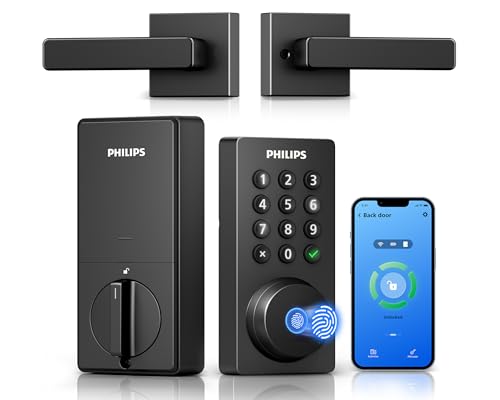
Hub-Free Management – Philips WiFi Keypad Deadbolt
The Philips 4200 Series is a smart lock for office setups that want built-in Wi-Fi and remote management without purchasing a separate hub. Its app handles user codes, fingerprints, lock status, and access history, while the included lever creates an all-in-one replacement set.
Best For: Offices that need remote status checks, scheduled access codes, and fingerprint entry from a compatible standard door.
Pros:
- Connects directly to 2.4GHz Wi-Fi without an additional hub or bridge.
- Supports permanent, one-time, periodic, and recurring PIN codes.
- Provides app-based access history, real-time status, fingerprint management, and remote locking or unlocking.
- Includes a matching handle and offers 0.3-second fingerprint access.
Cons:
- Requires a 2.4GHz router and recommends placement within 33 feet for connectivity.
- Batteries are not included, and the manufacturer specifies standard 1.5V alkaline batteries.
- Auto-lock is off by default and must be enabled in the app.
With built-in Wi-Fi and flexible code scheduling, this Philips lock is especially practical for offices with rotating staff or service providers. Verify door thickness and opening direction before installation.
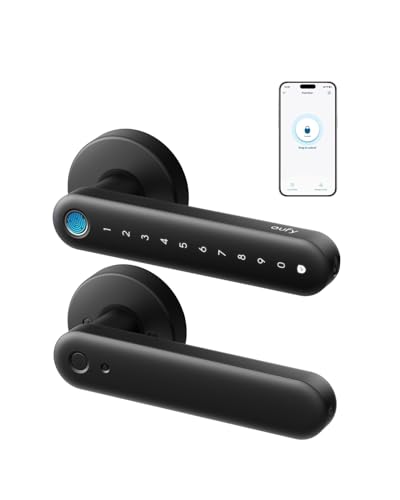
Interior Office Pick – eufy FamiLock C32
The eufy FamiLock C32 is a smart lock for office interiors, storerooms, and similar standard doors. It combines fast fingerprint recognition with built-in Wi-Fi, app management, auto-lock, and emergency USB-C power, though the manufacturer does not recommend it for front doors.
Best For: Interior office doors, private rooms, storage areas, and garage entries where remote management is useful.
Pros:
- Unlocks by fingerprint in about 0.3 seconds and supports 360-degree recognition.
- Built-in 2.4GHz Wi-Fi enables remote authorization and management.
- Four AA batteries are rated for more than five months, with USB-C emergency backup.
- Installs in about 15 minutes using only a screwdriver and works with Alexa and Google Assistant.
Cons:
- Not recommended for front-door use.
- Rekeying is not supported.
- Its stated battery life is over five months, shorter than some longer-life alternatives.
This is a focused option for interior office access rather than a universal exterior lock. Its built-in Wi-Fi and emergency power are useful for administrators, while the installation and standard-door fit keep setup straightforward.
High-Capacity Entry – 5-in-1 Biometric Door Knob
This 5-in-1 biometric door knob is a smart lock for office and apartment interiors that need several credential types in a compact, DIY-friendly design. It supports fingerprints, passwords, IC cards, app control, and mechanical keys, with capacity for multiple users and temporary access.
Best For: Small offices, private rooms, and indoor workspaces where administrators need flexible credentials and entry logs.
Pros:
- Combines fingerprint, password, IC-card, app, and mechanical-key access.
- Stores up to 100 fingerprints and 50 passwords.
- App supports permanent or temporary access, entry logs, and silent mode.
- Installs without drilling or wiring on compatible 1.18- to 1.97-inch wooden doors.
Cons:
- An administrator fingerprint must be registered before first use; otherwise, any fingerprint can unlock it.
- The USB port provides emergency power but does not recharge the internal batteries.
- It is specified for indoor use and may not suit exterior office doors.
This lock stands out for credential capacity and installation simplicity. It can work well for a small office with changing users, provided the door is a compatible wooden interior door and setup begins with administrator registration.
Best Wi-Fi Fingerprint Pick – eufy Security C33 Smart Lock
For shoppers seeking a smart lock for office use, the eufy Security C33 combines fingerprint entry, a back-lit keypad, built-in Wi-Fi, and app management in one handle-and-deadbolt design. It supports remote access, notifications, and event history, while its no-drill installation is designed for left- or right-hand doors.
Best For: Offices needing remote access management and multiple keyless entry options.
Pros:
- Offers fingerprint, passcode, app, and voice-control access.
- Built-in Wi-Fi supports remote control, notifications, and event history.
- Includes auto-lock, anti-peeping password protection, and IP53 resistance.
- Designed for approximately 15-minute, no-drill installation.
Cons:
- Requires eight AA batteries.
- Its 1.9 kg weight may be substantial for some door installations.
The C33 is a strong office-oriented choice when remote oversight and biometric access matter. Confirm that your door is compatible with its deadbolt format and plan for periodic battery replacement.
Best Offline Biometric Value – Q1 4-in-1 Smart Door Knob
This Q1 smart door knob is a practical smart lock for office doors when flexible entry and local biometric storage are priorities. It supports fingerprints, Tuya app control, keypad codes, and emergency keys, with capacity for up to 100 fingerprints, codes, or cards.
Best For: Small offices seeking fast, flexible access without cloud-stored biometric data.
Pros:
- Provides four entry methods: fingerprint, app, keypad, and key.
- Stores biometric data locally in an encrypted chip according to the supplied notes.
- Offers 0.5-second fingerprint recognition and a silent mode.
- Installs without drilling or wiring on compatible 1.18- to 1.97-inch wooden doors.
Cons:
- Uses Bluetooth connectivity rather than built-in Wi-Fi.
- Compatibility is specified for wooden doors within a particular thickness range.
- Its lock type is listed as privacy rather than deadbolt.
The Q1 emphasizes convenient, rapid entry and local data handling. It is best suited to compatible interior office doors where Bluetooth app control is sufficient and direct Wi-Fi connectivity is not essential.
Best for Managed Access – Yamiry YR01 Smart Door Handle
The Yamiry YR01 is a versatile smart lock for office environments that need several access methods and app-based user management. It supports fingerprints, passcodes, key fobs, mechanical keys, and Bluetooth app control, while a separately sold Wi-Fi gateway enables remote features and Alexa control.
Best For: Property managers, shared offices, and teams issuing temporary or recurring access.
Pros:
- Offers six listed access options, including fingerprint, app, code, fob, key, and voice or remote control with the required gateway.
- App can provide permanent or temporary access, generate one-time codes, and track unlock records.
- Installs in about 10 minutes using a screwdriver, without additional drilling.
- Includes two key fobs, two mechanical keys, an adjustable latch, and reversible-handle compatibility.
Cons:
- Wi-Fi remote control and Alexa features require a separately sold gateway.
- The supplied notes identify Bluetooth and Wi-Fi connectivity, but Wi-Fi functionality depends on that gateway.
- Its broad feature set may be more than needed for a single, low-traffic office door.
The YR01 stands out for access administration rather than just keyless entry. It makes the most sense where managers need temporary codes, unlock records, and multiple backup methods, provided the gateway requirement fits the setup.
Best No-App Value – Keypad Handle Lock
This keypad handle lock is a practical smart lock for office doors when you want code-based entry without an app, Wi-Fi, or Bluetooth. It supports up to 20 passcodes, auto-lock settings, passage mode, and straightforward screwdriver installation.
Best For: Small offices, rental properties, and interior doors needing simple shared access without connected features.
Pros:
- Creates up to 20 personalized 4–8 digit codes, including temporary one-time codes.
- Offers adjustable auto-lock from 5–99 seconds and a passage mode for busy periods.
- Installs in about 15 minutes and includes two backup keys.
- Backlit keypad, low-battery alerts, and IP54 weather resistance support everyday use.
Cons:
- Does not provide app, Wi-Fi, or Bluetooth control.
- Requires four AA batteries, which are not included.
- Its 20-code capacity may be limiting for larger workplaces.
Choose this model if uncomplicated access management matters more than remote monitoring. It is especially suitable for smaller offices where employees can use assigned codes and staff can rely on passage mode during operating hours.
Best Biometric Flexibility – Fingerprint Keypad Handle Lock
Fingerprint Door Lock - Smart Door Handle with Keypad, Biometric Door Knob for Bedroom, Home Office
Check Price On AmazonThis biometric smart lock for office or home-office doors combines fingerprint access with passwords, IC cards, app control, and mechanical keys. Its larger fingerprint sensor, emergency USB-C power port, and support for many users make it a versatile choice for shared spaces.
Best For: Home offices, bedrooms, and small workplaces that need multiple entry methods and substantial user capacity.
Pros:
- Provides five unlocking methods: fingerprint, password, IC card, app, and mechanical key.
- Stores up to 100 fingerprints and 50 passwords.
- Recognizes fingerprints in about 0.2 seconds and unlocks in about one second.
- Includes a USB-C emergency power port, two spare keys, and two IC cards.
Cons:
- Requires four AAA batteries, which are not included.
- App control is an added setup consideration compared with a keypad-only lock.
- Compatibility is specified for standard residential-style door dimensions, so commercial doors should be measured carefully.
This lock is a strong fit when employees or household members prefer different access methods. Verify your door dimensions before buying, particularly if installing it on a commercial office door rather than a standard residential-style door.
Best Connected Office Control – Philips Wi-Fi Smart Lock
The Philips Wi-Fi smart lock is a connected smart lock for office doors that need remote control, entry alerts, and activity tracking. It combines fingerprint access on the handle with app, password, voice, and physical-key options, while built-in 2.4GHz Wi-Fi works without a hub.
Best For: Small businesses, rental properties, and offices that benefit from remote unlocking, user management, and entry notifications.
Pros:
- Supports fingerprint, app, password, voice, and physical-key unlocking.
- Stores up to 50 fingerprints and 100 passcodes, including scheduled or temporary codes.
- Built-in Wi-Fi enables remote control, push alerts, and activity logs without a hub.
- Offers adjustable 5–180 second auto-lock, passage mode, and privacy mode.
Cons:
- Requires a 2.4GHz Wi-Fi connection and app setup for connected features.
- Its broader feature set may be more than needed for a basic office door.
- The supplied details do not specify battery type or battery quantity.
For managers who want visibility into office access, this is the most feature-rich option in the group. Remote operation, alerts, and event logs can simplify oversight, while multiple unlock methods help accommodate employees, guests, and service providers.
How We Picked the Best Smart Lock for Office
We focused on features that matter in small offices, home offices, studios, rentals, and shared workspaces: dependable entry methods, practical access management, installation requirements, connectivity, and emergency backup options. The selection includes fingerprint and keypad models, app-connected locks, and simpler no-Wi-Fi designs.
Because product specifications and compatibility can vary by listing, verify the current details before buying. Pay particular attention to door thickness, lock type, handle configuration, app requirements, and whether the lock is intended for an exterior entrance or an interior office door.
Quick Comparison
| Lock type | Best for | Main advantage | Potential drawback |
|---|---|---|---|
| Fingerprint and keypad | Small teams | Fast keyless entry | Biometric setup may require testing |
| Wi-Fi smart lock | Owners and managers | Remote access and monitoring | Usually depends on an app and batteries |
| App and fingerprint lock | Flexible staff access | Multiple ways to unlock | More setup and account management |
| Standalone keypad lock | Basic office doors | No Wi-Fi or app required | Limited remote control |
Key Buying Factors for a Smart Lock for Office Use
Door and Lock Compatibility
Confirm whether the product replaces a deadbolt, knob, or full handle set. Measure the backset, door thickness, bore hole, and available clearance before ordering. Some models are better suited to interior doors, while others are designed for front-door installation.
Access Control
Keypads are useful when several people need entry, especially if the lock supports multiple codes or temporary passcodes. Fingerprint access can be faster for regular users, while app control is helpful for remote unlocking and visitor access. Look for a physical key or another backup method in case batteries run low.
Connectivity and Management
A Wi-Fi model is usually the better Smart Lock for Office managers who need remote access, app notifications, or control while away. A no-Wi-Fi keypad may be preferable for a small office that wants simple operation, fewer privacy concerns, and less dependence on network connectivity.
Power, Security, and Daily Use
Review battery type, low-battery alerts, auto-lock settings, and emergency power options. Choose a lock with a construction and weather rating appropriate for its location. Auto-lock can improve security, but set the delay carefully so it does not lock people out unexpectedly.
Who Should Buy Which Smart Lock for Office?
- Small teams: Choose a fingerprint-and-keypad model with several stored users and a reliable key backup.
- Remote owners: Select a built-in Wi-Fi lock with app control, notifications, and temporary code support.
- Simple office setups: A standalone keypad lock is a practical choice when remote access is unnecessary.
- Shared or frequently changing spaces: Prioritize app management, passcode creation, and easy user removal.
- Interior offices: Check that the lock is designed for the specific interior door and does not require exterior-grade hardware.