Choosing the right spindle sander can make curved edges, inside corners, and cleanup work faster and more accurate in a small shop.
This roundup focuses on compact, practical machines that balance footprint, power, dust control, and ease of use for real workshop constraints.
Best 10 Spindle Sanders for Small Workshops Picks for 2026
Bench-Ready Dust-Control Sander
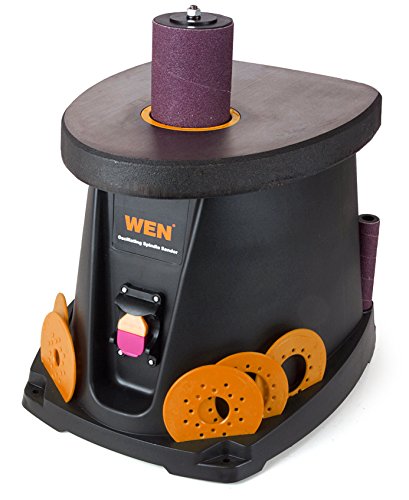
- 3.5 amp motor with 58 OPM and 2000 RPM
- Onboard storage keeps accessories together
- Dust collection port helps minimize cleanup
Best For: Small workshops needing a compact benchtop sander with basic organization
Cast-Iron Curve Specialist

- Rotating and oscillating action for contour sanding
- Cast iron top for stable bench use
- Includes 6 sleeves, drums, and inserts
Best For: Small workshops focused on curves and irregular shapes
Portable Handheld-to-Bench Sander
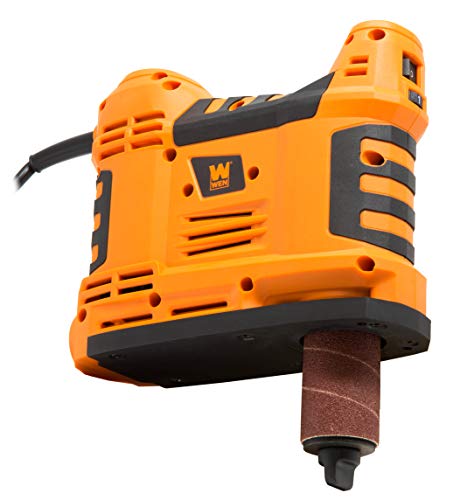
- Works as handheld or clamped benchtop sander
- 5-amp variable speed from 1800 to 3200 RPM
- Includes four spindle sizes and dust port
Best For: Small workshops that want a versatile, space-saving sander
Space-Efficient Wide-Table Sander

- 2000 RPM motor with 0.59-inch stroke
- 12.5 x 11.5-inch cast aluminum table
- Six sleeves, six inserts, and built-in storage
Best For: Small workshops needing a roomy, organized benchtop sander
Space-Saving Combo Choice
WEN 6524 Oscillating Belt and Spindle Sander
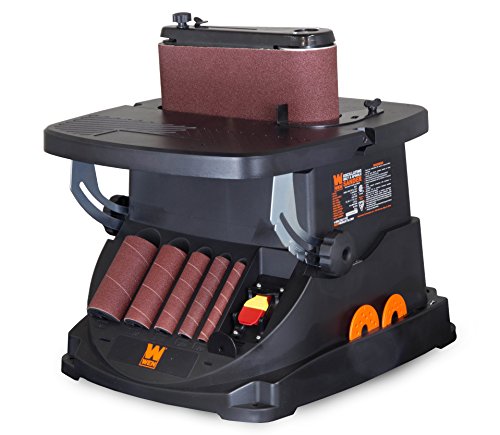
- Spindle and belt sanding in one machine
- Onboard storage for accessories and sandpaper
- 58 oscillations per minute with 5/8-inch stroke
Best For: Small workshops that need a versatile combo sander
Portable Versatility Pick
Triton TSPSP650 Portable Oscillating Spindle Sander

- Portable handheld or bench-mounted use
- Variable speed from 1800 to 3200 rpm
- Tool-free quick-change sleeves and drums
Best For: Small shops that need portability and bench-mounted flexibility
Power-Forward Compact Pick
Woodskil Variable Speed Oscillating Spindle Sander for Wood, 4A

- 2/3HP 4A motor for tougher sanding
- Variable speed from 1000 to 1800 rpm
- Six sleeves from 1/2 inch to 3 inches
Best For: Small workshops needing a compact, higher-power spindle sander
Shop-Friendly Pick
WEN AT6535 3.5-Amp Oscillating Spindle Sander
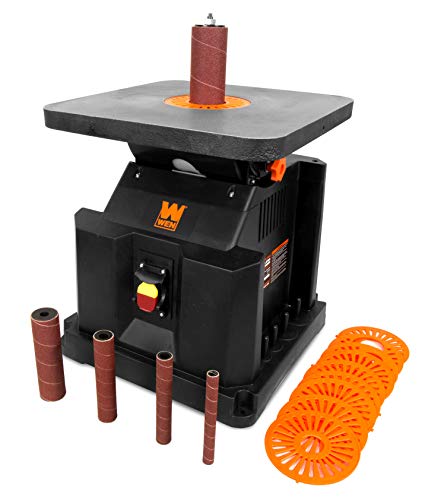
- Five sleeve sizes for different curve diameters
- Large table bevels to 45 degrees
- Onboard storage keeps accessories organized
Best For: Small workshops needing a practical, organized benchtop sander
Heavy-Duty Value
Rikon 50-300 Oscillating Spindle Sander

- All-steel build with heavy-duty gearing
- Five spindle diameters from 1/2 in. to 2 in.
- Cast iron tilting table with 6 inserts
Best For: Small workshops wanting a durable, substantial benchtop sander
Premium Benchtop Choice
JET JBOS-5 Oscillating Spindle Sander
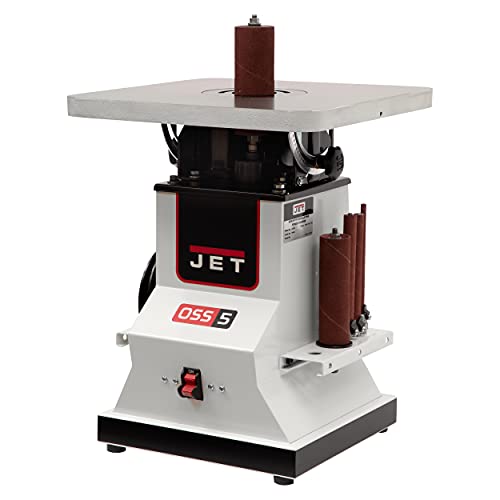
- Precision bearings and sealed gearing
- Cast iron table tilts to 45 degrees
- Built-in storage for spindles and inserts
Best For: Small workshops needing a durable, precision-focused benchtop sander
Bench-Ready Dust-Control Sander – WEN 6510T
For spindle sanders for small workshops, the WEN 6510T is a straightforward benchtop pick with a 3.5 amp motor, 58 OPM oscillation, and 2000 RPM speed. It’s built to handle contoured edges and curved work while keeping cleanup easier thanks to onboard accessory storage and a dust collection port.
Best For: Small shops that want a compact, corded spindle sander with simple storage and dust hookup.
Pros:
- 3.5 amp motor delivers 58 OPM and 2000 RPM for steady sanding.
- Onboard storage keeps accessories organized in a tight workspace.
- Dust collection port helps reduce cleanup.
- Benchtop format suits routine curve and contour work.
Cons:
- No variable-speed control listed.
- Heavier than a portable handheld option at 30.2 pounds.
Overall, the WEN 6510T fits small workshops that prioritize a simple bench machine with useful dust management and built-in storage over extra adjustability.
Cast-Iron Curve Specialist – Triton TSPS450
When you’re comparing spindle sanders for small workshops, the Triton TSPS450 stands out for contour work with rotating and oscillating action, a 3.5A motor, and a cast iron top. It’s designed for sanding arcs, curves, and other irregular shapes, and it includes multiple sleeves and inserts to support different diameters.
Best For: Small shops that want a sturdy benchtop sander for curves, contours, and irregular shapes.
Pros:
- Rotating and oscillating action supports faster, finer contour sanding.
- Cast iron top adds a stable work surface.
- Includes 6 sanding sleeves, matching rubber drums, and table inserts.
- On-board storage keeps accessories close at hand.
Cons:
- Benchtop design takes up dedicated workspace.
- No variable-speed range is listed.
The Triton TSPS450 is a practical fit for small workshops that need a stable, purpose-built machine for irregular shapes and value included accessories.
Portable Handheld-to-Bench Sander – WEN HA5932
For spindle sanders for small workshops, the WEN HA5932 offers a flexible setup that can be used as a lightweight handheld unit or clamped to a workbench as a stationary sander. Its 5-amp variable-speed motor, 1/4-inch stroke, and multiple spindle sizes make it useful when space is tight and the sanding tasks vary.
Best For: Small workshops that need a portable spindle sander that can also work as a benchtop unit.
Pros:
- Lightweight portable design is easier to move and use in hard-to-reach spots.
- Clamps to a bench with included hardware for stationary use.
- Variable speed from 1800 to 3200 RPM and 50 to 90 OPM adds flexibility.
- Includes four spindle diameters plus dust port and accessories.
Cons:
- Handheld format may be less rigid than a dedicated benchtop machine.
- Setup is more involved if you switch between portable and stationary use often.
This model makes sense for compact shops that need one tool to cover both detail sanding and bench work without dedicating much floor space.
Space-Efficient Wide-Table Sander – VEVOR OSM-1
If you’re shopping spindle sanders for small workshops, the VEVOR OSM-1 offers a bench-friendly layout with a 12.5 x 11.5-inch cast aluminum table, 2000 RPM speed, and a 0.59-inch stroke. It’s set up for furniture finishing, crafts sanding, and DIY woodworking, while the integrated storage helps keep sleeves and inserts from cluttering your bench.
Best For: Small workshops that want a stable benchtop sander with a roomy table and organized accessory storage.
Pros:
- 12.5 x 11.5-inch cast aluminum table provides a spacious work area.
- 0.59-inch stroke supports thin and thick workpieces.
- Six sleeve sizes and six table inserts cover a wide range of curves.
- Integrated slots help keep accessories organized.
Cons:
- Dedicated benchtop footprint may be a consideration in very tight shops.
- Dust port size details may require checking hose compatibility before setup.
The VEVOR OSM-1 is a strong option for small workshops that need a stable sanding station with generous table space and easy accessory organization.
Space-Saving Combo Choice – WEN 6524 Oscillating Belt and Spindle Sander
If you’re shopping for spindle sanders for small workshops, the WEN 6524 is a strong space-conscious option because it combines spindle and belt sanding in one corded machine. It comes with multiple drum sizes, a 4 x 24-inch belt, and onboard storage to help keep accessories organized in a compact shop.
Best For: Woodworkers who want a single benchtop machine for curved sanding, belt sanding, and organized accessory storage in a small shop.
Pros:
- Includes five throat plates, four rubber sanding drums, and one belt sanding attachment
- Offers 58 oscillations per minute with a 5/8-inch stroke for sanding curves and contours
- Onboard storage helps keep sandpaper and accessories organized
- Comes with a beveling work table for added setup flexibility
Cons:
- At 27 pounds, it’s not the lightest option for frequent moving
- Single-speed specs for the belt and spindle are not especially flexible compared with variable-speed models
This WEN model makes sense if you want a practical all-in-one sander that can cover more than spindle work without taking up extra room. Its mix of attachments and storage is especially useful when bench space is limited.
Portable Versatility Pick – Triton TSPSP650 Portable Oscillating Spindle Sander
For buyers comparing spindle sanders for small workshops, the Triton TSPSP650 stands out because it can work as a portable handheld edge sander or as a bench-mounted spindle sander. Its 650W motor, variable speed range, and quick-change sleeve system make it a flexible fit for detailed woodworking tasks.
Best For: Users who want a lightweight, portable spindle sander that can also be bench-mounted for more stable work.
Pros:
- Portable design offers handheld edge sanding and bench-mounted use
- Variable speed from 1800 to 3200 rpm supports different tasks
- Quick-change system makes drum and sleeve changes tool-free
- Includes an inverted bench-mounting set, dust port adaptor, and adjustable edge guide
Cons:
- Smaller tool size may not suit users who want a larger bench-only setup
- Included drum sizes are limited to 1/2, 3/4, 1 1/32, and 1 1/2 inches
The Triton is a smart pick if versatility matters more than a dedicated stationary footprint. It’s especially appealing for small shops that also need a tool they can move or adapt for different sanding jobs.
Power-Forward Compact Pick – Woodskil Variable Speed Oscillating Spindle Sander for Wood, 4A
Among spindle sanders for small workshops, the Woodskil model is aimed at users who want more power without giving up a compact footprint. Its 4A motor, variable speed range, and six sleeve sizes make it a practical choice for hardwood, contours, slots, and other detail work.
Best For: Woodworkers and DIY users who want a compact spindle sander with stronger motor power and variable speed control.
Pros:
- 2/3HP 4A motor provides extra power for tougher sanding jobs
- Variable speed from 1000 to 1800 rpm offers better control
- Includes six sanding sleeves from 1/2 inch to 3 inches
- Dust port supports vacuum connection for cleaner workspaces
Cons:
- At 26 pounds, it still takes up dedicated bench space
- No belt-sanding function is included
This Woodskil sander is a solid fit if your small workshop needs a dedicated spindle machine with more muscle than entry-level models. The combination of variable speed, larger sleeve range, and dust port makes it well suited to regular use.
Shop-Friendly Pick – WEN AT6535 3.5-Amp Oscillating Spindle Sander
WEN AT6535 3.5-Amp Oscillating Spindle Sander with Extra Large Beveling Table Top
Check Price On AmazonFor spindle sanders for small workshops, the WEN AT6535 gives you a compact benchtop setup with a roomy 14-1/2 by 14-1/2-inch table and a 3.5-amp motor that handles everyday curved sanding tasks. It includes five sleeve sizes and onboard storage, which helps keep accessories organized when bench space is tight.
Best For: Small workshops that need a straightforward benchtop spindle sander with useful size range and built-in storage.
Pros:
- Five sanding sleeve sizes: 1/2 in., 3/4 in., 1 in., 1-1/2 in., and 2 in.
- 2000 RPM motor with 58 oscillations per minute and a 5/8-inch stroke
- Large 14-1/2 by 14-1/2-inch table bevels up to 45 degrees
- Onboard storage helps keep accessories and sandpaper organized
Cons:
- Heavier than a true portable tool at 33.2 pounds
- Table size is generous, but the unit still needs dedicated bench space
This model focuses on practical features rather than extras, making it a sensible fit if you want a capable spindle sander that stays organized and covers a broad range of curved workpieces.
Heavy-Duty Value – Rikon 50-300 Oscillating Spindle Sander
The Rikon 50-300 is a solid choice among spindle sanders for small workshops if you want an all-steel machine built for fast, accurate sanding of curved board edges. Its 1/2 HP motor, cast iron tilting table, and multiple spindle diameters give it a more substantial feel than lighter benchtop options.
Best For: Small shops that want a heavy-duty spindle sander with an all-steel build and broad accessory coverage.
Pros:
- All-steel construction with heavy-duty gearing
- Includes 5 spindle diameters from 1/2 in. to 2 in.
- 29 oscillations per minute with a 15/16-inch stroke for curved-edge sanding
- Cast iron tilting table and 6 table inserts included
Cons:
- At about 80 pounds, it is one of the heavier benchtop options
- May take up more space than lighter, more compact models
If your workshop can handle the extra weight, this model offers a durable, feature-rich setup that is well suited to repeated curved sanding work.
Premium Benchtop Choice – JET JBOS-5 Oscillating Spindle Sander
Among spindle sanders for small workshops, the JET JBOS-5 stands out for its precision-oriented design and cast iron construction. It uses ball bearings, sealed gearing, and a 1/2 HP motor, making it a strong benchtop option for consistent sanding on curved and beveled projects.
Best For: Small workshops that want a refined benchtop spindle sander with durable internal mechanisms and organized storage.
Pros:
- Precision ball bearings and worm-and-gear oscillation for consistent performance
- 14-1/2 by 14-1/2-inch cast iron table tilts to 45 degrees
- Built-in storage racks keep spindles and table inserts handy
- Includes multiple spindle assemblies from 1/4 in. to 2 in.
Cons:
- At 75.6 pounds, it is not a lightweight benchtop tool
- Uses a 1/2 HP, corded setup, so it is geared more toward workshop use than mobility
The JBOS-5 is a strong fit when you want a compact machine with workshop-friendly storage and durable mechanisms that support repeatable sanding results.
How We Picked These Spindle Sanders for Small Workshops
We prioritized machines that make sense in limited space: manageable footprints, stable bases, useful table size, straightforward controls, and dust collection that helps keep a small area cleaner. We also considered spindle range, oscillation action, build quality, and whether the tool is better suited to light hobby use or more frequent shop work.
Quick Comparison: What Matters Most
When comparing Spindle Sanders for Small Workshops, look beyond motor size alone. A lighter benchtop unit may be easier to store and move, while a heavier cast-iron machine often feels more stable during longer sanding sessions. Variable speed can help match the abrasive to softer woods or delicate curves, and combo belt-and-spindle models add versatility if you only want one sander on the bench.
Key Buying Factors for Spindle Sanders for Small Workshops
Footprint and Stability
In a compact shop, the best sander is one that fits your bench without crowding other tools. That said, a tiny machine that walks across the table is frustrating, so balance size with weight and base design.
Oscillation, Speed, and Spindle Range
Oscillation helps reduce sanding marks and improves finish quality on curves. Variable speed is useful if you work with thin stock, hardwood, or intricate profiles. Make sure the spindle sizes included match the curves and openings you actually sand most often.
Dust Collection
Dust control matters even more in smaller spaces. A proper dust port, compatible hose size, and decent airflow can make cleanup easier and improve visibility at the table.
Table and Fence Features
A larger or tilting table can improve support on awkward parts. For detail work, easy adjustment and a flat, rigid surface often matter more than extra bells and whistles.
Power Vs. Portability
Portable units are appealing for mobile or multi-use shops, while heavier benchtop models are usually better if the machine will stay put. If you sand often, prioritize smooth operation and stability over the smallest possible size.
Who Should Buy Which Spindle Sanders for Small Workshops?
Choose a basic benchtop model if you need an affordable, space-saving sander for occasional curve cleanup. Pick a variable-speed or more powerful option if you work with a wider mix of materials or want finer control. If you value versatility and can spare a little extra bench room, a combination belt-and-spindle machine may be the most practical long-term choice for Spindle Sanders for Small Workshops.