If you rely on a private well, your water can change with the seasons, your plumbing, and even nearby weather. A good whole-house system helps protect every tap, appliance, and shower in the home.
Below, we’ve rounded up 10 of the best water filtration systems for well water in 2026, with options for different water problems, flow needs, and maintenance preferences.
Best 10 Water Filtration System for Well Water Picks for 2026
Pro Grade 3-Stage Protection
PRO+AQUA Elite GEN2 Whole House System

- 3-stage design for sediment, metals, odors, and chemicals
- Made for 1-3 bathroom homes with 1" ports
- Pressure gauges help track filter condition
Best For: Small to medium homes on well water that want monitored whole-house filtration
Heavy-Duty Whole-Home Defense
Express Water Ultimate Protection 3-Stage

- Targets chlorine, heavy metals, and scale buildup
- Stainless steel stand with gauges and release buttons
- No power required and supports up to 17 gpm
Best For: Whole-home protection when scale control and heavy-duty construction matter
Maintenance-Friendly Metal Reduction
WF3-01 3-Stage Whole House Filter

- Covers sediment, chlorine, VOCs, odors, and heavy metals
- Built-in gauges, timers, and service valves
- Includes brush, adapters, and maintenance card
Best For: Buyers who want easy upkeep and broad contaminant reduction
Long-Life UV Protection
Aquasana WH-1000-CS-UVS-B Whole House System

- Adds UV treatment to carbon, KDF, and scale control
- Rated for up to 1 million gallons or 10 years
- Reduces 97% of chlorine and tackles bacteria/viruses
Best For: Larger households wanting long-life filtration with UV and salt-free scale control
Whole-Home Basics
iSpring WGB21B 2-Stage Whole House Filter
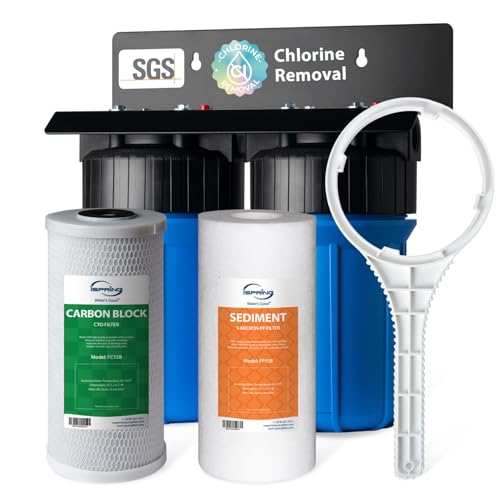
- 5-micron sediment plus CTO carbon filtration
- Rated up to 50,000 gallons for whole-house use
- Pre-assembled with wrench and pressure valve
Best For: Homes needing simple whole-house sediment and chlorine reduction
High-Capacity Family Pick
Whole House 3-Stage Filter with 9 Cartridges

- 0.5-micron 3-stage filtration for chlorine, rust, and odors
- Includes 9 filters total for about 1 to 2 years
- Clear housings make debris and replacement easy to see
Best For: Families wanting long filter life and strong whole-house flow
Iron Removal Upgrade
iSpring WGB32BM Whole House Filter

- Dedicated stage reduces iron and manganese
- Also tackles sediment, chlorine, rust, and odors
- Up to 100,000 gallons with 15 GPM flow
Best For: Well water with iron, manganese, and sediment concerns
All-in-One Whole House Setup
3-Stage Whole House Filter, 9 Filters

- Includes 3 complete filter sets for 1.5-2 years
- Works with well water and city water
- Built-in shut-off valves simplify maintenance
Best For: Families wanting a long-lasting whole-house filter with easy changes
High-Flow Whole House Protector
Waterdrop WHF3T-PG 3-Stage Filter

- Claims 97.72% chlorine reduction
- Supports well water and municipal sources
- 15 GPM flow rate with durable construction
Best For: Homes that want strong flow and broad whole-house filtration
Well Water Value Pick
3-Stage Whole House Filter, 2-Year Supply

- Includes 3 full sets of cartridges
- Built-in shut-off valves simplify changes
- Targets chlorine, sediment, and odors
Best For: Families wanting a simple, low-maintenance whole-house filter
Pro Grade 3-Stage Protection – PRO+AQUA Elite GEN2 Whole House System
If you need a water filtration system for well water that can handle sediment, heavy metals, odors, and common chemical issues, this PRO+AQUA 3-stage whole house system is built for exactly that kind of job. It’s designed for small to medium homes and uses a staged setup to protect both water quality and household plumbing.
Best For: Small to medium households on well or city water that want a low-maintenance, whole-home filter with pressure monitoring.
Pros:
- 3-stage filtration targets sediment, heavy metals, hydrogen sulfide odors, VOCs, pesticides, and other chemicals.
- Built for 1-3 bathroom homes with 1″ ports and a listed 15 gpm maximum flow rate.
- Includes stainless steel pressure gauges for easier monitoring and filter replacement timing.
- No regeneration, backwash, draining, or electricity required.
Cons:
- Filters need replacement every 6 months for best performance.
- Professional installation is specified, so it may not suit DIY buyers.
Overall, this is a practical whole-house option if you want broad contaminant reduction and a system that is straightforward to maintain. The clear sediment housing and lifetime US tech support add to its appeal for well water households.
Heavy-Duty Whole-Home Defense – Express Water Ultimate Protection 3-Stage
This water filtration system for well water is aimed at homeowners who want whole-house coverage with a focus on chlorine, heavy metals, and scale control. The Express Water 3-stage setup uses a stainless steel stand, pressure gauges, and pressure release buttons to make installation and maintenance easier.
Best For: Homes that need a heavy-duty whole-house filter with anti-scale protection and broad contaminant reduction.
Pros:
- 3-stage filtration is designed to reduce chlorine, heavy metals, and scale buildup.
- Includes a stainless steel bracket/stand plus pressure gauges for monitoring.
- 1″ connections support up to 17 gpm at 45-80 PSI, according to the notes.
- Manual system with no power source required.
Cons:
- Does not reduce TDS.
- Filters are scheduled for replacement every 6-12 months, depending on water quality and use.
If your priority is protecting plumbing and appliances while improving water throughout the house, this model covers the basics well. It’s especially appealing if scale prevention is a major concern in your water supply.
Maintenance-Friendly Metal Reduction – WF3-01 3-Stage Whole House Filter
For buyers comparing a water filtration system for well water, this WF3-01 model stands out for combining contaminant reduction with maintenance features. It uses three big Blue filters and includes pressure gauges, timers, valves, and even a housing brush to simplify upkeep.
Best For: Homeowners who want whole-house filtration with easy service features and built-in maintenance reminders.
Pros:
- Reduces sediment, chlorine, VOCs, odors, and heavy metals including lead, mercury, arsenic, cadmium, and chromium.
- Includes pressure gauges and 180-day countdown timers to help track filter life.
- Comes with pressure relief/drain valves, a housing brush, adapters, and a maintenance record card.
- Flexible bracket-mounted or free-standing setup with 3/4″ or 1″ NPT conversion options.
Cons:
- Listed as under-sink installation in the provided specs, which may confuse shoppers expecting a typical whole-house setup.
- Filters are still maintenance items, so this is not a set-and-forget system.
This is a strong choice if you want whole-home water treatment with more built-in service tools than many competitors. The included timers and accessories make routine upkeep more manageable.
Long-Life UV Protection – Aquasana WH-1000-CS-UVS-B Whole House System
If you’re looking for a premium water filtration system for well water, this Aquasana whole-house unit adds UV treatment and salt-free scale control to a multi-stage carbon and KDF setup. It is designed for homes that want cleaner water at every tap while also addressing bacteria, viruses, and scale concerns.
Best For: Larger households that want long-life whole-house filtration with UV treatment and salt-free scale control.
Pros:
- Combines carbon, KDF, UV, and salt-free scale control media in a multi-stage system.
- Claims to reduce 97% of chlorine and tackle bacteria, viruses, and scale.
- Long service life of up to 1 million gallons or 10 years, backed by a 10-year limited warranty.
- No salt bags, backwashing, or cleaning required for the scale-control component.
Cons:
- Best for moderate hardness conditions under the listed water quality limits.
- Uses a corded electric UV component, so it is not a fully passive setup.
For households that want extended filter life and added microbial protection, this Aquasana package is one of the most feature-rich options in the lineup. It is especially compelling if you want scale management without traditional salt-based softening.
Whole-Home Basics – iSpring WGB21B 2-Stage Whole House Filter
If you want a straightforward water filtration system for well water at the point where it enters the house, the iSpring WGB21B is built to handle sediment, chlorine, taste, and odor without adding complexity. Its two-stage design is practical for homes that need cleaner water at every tap while keeping healthy minerals in place.
Best For: Homeowners who want a simple, high-flow whole-house filter for basic well water cleanup.
Pros:
- Two-stage setup uses a 5-micron sediment filter plus a CTO carbon block filter.
- Claims to remove over 90% of chlorine and help reduce VOCs like pesticides and solvents.
- 10″ x 4.5″ cartridges are rated up to 50,000 gallons or about one year for a family of four.
- Pre-assembled bracket, included wrench, and pressure release valve make filter changes easier.
Cons:
- Does not reduce TDS, so it is not an RO-style purification system.
- Focused on sediment, chlorine, taste, and odor rather than iron or manganese.
Overall, this is a solid entry-level whole-house option if your well water mainly needs sediment and chlorine reduction. It balances flow, ease of maintenance, and broad household coverage without overcomplicating the install.
High-Capacity Family Pick – Whole House 3-Stage Filter with 9 Cartridges
This water filtration system for well water is aimed at households that want strong flow and a longer filter supply out of the box. With 0.5-micron filtration, three stages, and included replacement sets, it is designed to reduce chlorine, rust, sediment, and odors while keeping maintenance simple.
Best For: Families with well or city water who want a long-lasting, high-flow whole-house filter package.
Pros:
- 0.5-micron, 3-stage filtration is designed to reduce chlorine, rust, sediment, and odors.
- Includes 9 filters total, giving roughly 1 to 2 years of use with replacement sets included.
- 15 GPM flow rate helps maintain pressure when multiple taps are running.
- Clear housings let you visually monitor debris buildup and replacement timing.
Cons:
- Does not reduce TDS, so mineral content remains unchanged.
- Uses 3/4″ inlet/outlet connections, which may not match every home setup.
This is a convenient buy if you want fewer cartridge purchases and visible filter monitoring from the start. It is especially appealing for well-water homes that need broad contamination reduction with a ready-to-go replacement supply.
Iron Removal Upgrade – iSpring WGB32BM Whole House Filter
If your well water has iron or manganese issues in addition to sediment and chlorine, the iSpring WGB32BM is built for that extra challenge. It adds a dedicated iron and manganese reduction stage while still handling the usual whole-house basics like taste, odor, rust, and sediment.
Best For: Well water homes dealing with iron and manganese along with everyday filtration needs.
Pros:
- Third-stage media is specifically designed to reduce iron up to 3.0 ppm and manganese up to 1.0 ppm.
- Also reduces sediment, chlorine, rust, herbicides, and industrial solvents.
- Large 20″ x 4.5″ cartridges and 1″ inlet/outlet support up to 15 GPM flow.
- Rated up to 100,000 gallons, with cartridges tested to meet NSF/ANSI standards.
Cons:
- Does not reduce TDS, so dissolved minerals stay in the water.
- Heavier, larger system may take more space for installation.
For well water that leaves orange stains, metallic taste, or manganese-related problems, this is the most targeted option in the group. It offers broader treatment than a basic carbon filter while still keeping whole-house flow and maintenance practical.
All-in-One Whole House Setup – 3-Stage Whole House Filter, 9 Filters
If you want a water filtration system for well water that focuses on sediment, chlorine, and odors, this 3-stage whole house setup is built for practical everyday use. It works with both well and city water, includes three full filter sets, and is designed to fit standard 3/4″ plumbing with easy shut-off valves for simpler maintenance.
Best For: Homes that want an all-in-one whole-house filter with long replacement intervals and easy filter changes.
Pros:
- Includes 9 filters total, giving you about 1.5-2 years of supply
- Built-in shut-off valves make filter changes easier without turning off the main line
- Designed for both well water and city water
- Helps reduce chlorine, sediment, and odors throughout the home
Cons:
- Does not reduce TDS
- Uses 3/4″ ports, so it may not match every plumbing setup
- Focuses on basic filtration rather than advanced contaminant removal
Overall, this is a straightforward whole-house option for households that want cleaner-tasting water and simpler upkeep. The included filter supply and bypass-style design make it appealing if you prefer fewer replacement purchases and easier routine service.
High-Flow Whole House Protector – Waterdrop WHF3T-PG 3-Stage Filter
For shoppers comparing a water filtration system for well water, this Waterdrop whole house model is aimed at homes that want strong flow and broad particle reduction. It is designed to support both well water and municipal sources, with a 3-stage design that targets chlorine, odor, taste, sediment, rust, and sand while keeping water delivery steady.
Best For: Households that want a high-flow whole-house filter with chlorine reduction and durable construction.
Pros:
- Claims 97.72% chlorine reduction with KDF composite and GAC filtration
- Supports both well water and municipal water sources
- 15 GPM flow rate helps maintain steady household water supply
- NSF/ANSI 372 certified for lead-free materials
Cons:
- Filter life depends on water quality, even though it is rated for 12 months
- Uses a 1″ inlet/outlet, so plumbing compatibility should be checked
- Does not claim to reduce TDS
This model stands out if you want a sturdier whole-house system with a focus on flow, chlorine removal, and basic protection for appliances. It is a solid fit for homes that need a dependable filter without giving up pressure.
Well Water Value Pick – 3-Stage Whole House Filter, 2-Year Supply
If you need a water filtration system for well water that is easy to live with, this 3-stage whole house system emphasizes convenience and long-term supply. It comes with three full sets of cartridges, built-in shut-off valves, and a compact design that can work under a sink or in a utility area while improving water quality across the home.
Best For: Families that want a practical well water filter with a long cartridge supply and simple maintenance.
Pros:
- Includes 3 full sets of filters for roughly 1.5-2 years of use
- Built-in shut-off valves make filter swaps easier
- Designed for well water or city water
- Helps reduce chlorine, sediment, and odors for whole-home use
Cons:
- Does not lower TDS
- Uses standard 3/4″ plumbing, so compatibility matters
- Basic filtration focus may not suit users needing advanced contaminant removal
As a whole-house option, this one is geared toward simple ownership rather than complex filtration features. The long included filter supply and easy-change valves make it appealing for households that want a low-maintenance starting point for cleaner water.
How We Picked the Best Water Filtration System for Well Water
We focused on whole-house filters built to handle common well-water issues such as sediment, iron staining, chlorine taste and odor, heavy metals, and in some cases bacteria reduction support. We also looked at filtration stages, micron ratings, flow rate, filter lifespan, and whether the system is better suited to light treatment or more demanding well water conditions.
Quick Comparison of the Best Options
If your main concern is sediment, a multi-stage system with a finer micron rating is usually the better fit. If you also deal with iron or manganese, choose a system specifically designed for those contaminants. For homes that want broader protection and less frequent filter changes, longer-life systems with larger cartridges or UV support can be worth the higher upfront cost.
Key Buying Factors for a Water Filtration System for Well Water
Water Test Results
Start with a lab test or at least a detailed home test. Well water can contain sediment, iron, sulfur smell, hardness, tannins, or microbes, and no single system handles everything equally well.
Contaminants You Need to Remove
Match the system to the problem. Sediment and cloudiness call for particulate filtration. Iron and manganese need dedicated media. If taste and odor are the issue, activated carbon is important. For microbial concerns, look for UV or certified disinfection support rather than filtration alone.
Flow Rate and Home Size
A whole-house system should support showers, laundry, and appliances without a big pressure drop. Larger homes and higher fixture demand usually need higher GPM ratings and larger housings.
Filter Life and Maintenance
Check replacement intervals and cartridge cost before you buy. A cheaper system can become expensive if filters need frequent changes. The best Water Filtration System for Well Water balances performance with maintenance you can realistically keep up with.
Installation Space and Plumbing Compatibility
Measure your installation area and verify inlet and outlet size, especially if you’re replacing an existing system. Some units are more DIY-friendly than others, but many homeowners still prefer professional installation for bypass valves, pressure monitoring, and leak prevention.
Who Should Buy Which Water Filtration System for Well Water?
If your well water has heavy sediment or general taste and odor issues, a standard 3-stage whole-house system is often the best starting point. If iron stains or metallic taste are the main complaints, choose a model made for iron and manganese reduction. If you want broad household protection with added microbial defense, look for systems that pair carbon filtration with UV treatment. Homes with higher water usage should prioritize higher flow and longer filter life, while smaller households may prefer a simpler, lower-maintenance setup.
For most buyers, the best choice is the system that matches the actual water test, not the one with the most stages. That approach delivers better results, lower maintenance costs, and cleaner water at every tap.